
T22
A program with regional characteristics design for Yingge’s and other traditional industries revitalizing from changing environment
REVITALIZATION PROGRAM WITH REGIONAL CHARACTERISTICS DESIGN
Client :

Duration
Team
2 Months
2019
Yung-Hsuan Lin
Rubi Liu
My Primary Role
Primary research
The qualitative and quantitative research
Report writing
Tool
Illustrator
Brief
How might we help Taiwan’s traditional industries be supported?
Solution Overview
A new way for TDRI to revitalize the region by proactively selecting whether the local industry is valuable or not,
promoted sustainable development in changing environment.
1.1 Understanding the context
Industry lifecycle analysis:
•We started the project by figuring out the current situation of Yingge's ceramics industry. So we have mapped out
Yingge's ceramics industry into a financial lifecycle map, analysing the proccess of development.
•The map shows that the Yingge ceramics industry has entered a period of decline since 1995.


Understanding the background of Yingge’s ceramics industry:
Major traditional Manufacturing Industries clusters of Taiwan
•Yingge is a small town famous for producing pottery, containing beautiful pottery shops, historic buildings and old factories, and was once Taiwan's most attractive tourist attraction. However, the current Yingge ceramics industry is one of the most declining traditional industries in Taiwan.
There are still many declining traditional industries like Yingge in Taiwan, and the establishment of regional brands is the key to revitalizing these industries
1.2 The reason for the decline of the Yingge ceramics industry is not single. The environment is complex. Often these issues overlap and can be exacerbated as time goes by.
_edited.jpg)
• What does decling traditional industry look like?
• What are key trends lead to the decline of industry?
The conflict of interests and the uneven funding allocation has limited the development of the industry. Shops in the old street are profit-oriented, and importing cheap porcelain leads to products that lack innovative and unique value. On the other hand, shops outside the old street difficult to obtain economic benefits due to the commercial location.
1.3 Interview
We did not think that this was a complete view of the Yingge ceramics industry and environment. We analyzed the interview with local shops and created a matrix using axial coding. The content of the map is made by 4 questions:

1.4 Research on regional brand and industrial cluster
Understanding the benefits of place branding for urban transformation
Understanding the relationship between Yingge and Taiwan's industrial clusters
• Belong to the people's livelihood industry and creative industry
• Close to the daily consumption and use has benefit to establishing a regional brand
Phase II - Defining
2.1 Problems & Pain points
For Yingge's ceramics industry
Declining market demand is the main driving factor for the decline of the Yingge industry
1. Low product innovation
2. Unstable and vulnerable to the Chinese market
3. Uncompetitive production and price
4. Low demand for younger generations
5. Unefficient cooperation between local organizations
6. Insufficient concept of brand marketing
For Government
How does the government choose a declining industry like Yingge to cultivate as a priority within limited resources in the future?
User Group

Age:42
Job: 2nd generation of small business
Status: Married
Location: Yingge
Introduction:
Max is a hard worker, he runs a ceramics shop in old street. He took over running the store from his father, but business was not good.
Target:
Yingge is revitalized, and he can earn more money to support his family.
Frustration:
It's bad business. Feel worried for future life.
How Might We...
Bring the tourists back to Yingge?
Phase III - Developing
3.1 Introducing our Service:

Establish the correct coaching direction and marketing structure.
We want to revitalize traditional industries like Yingge and others. The government selects the industries to support and coach the development of the local economy. Finally, building a regional brand.
3.2 How does it work for the user?
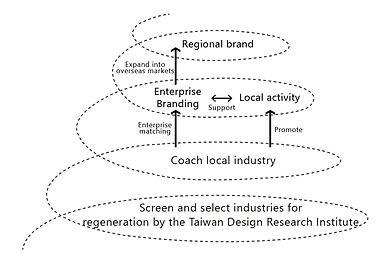
• Conducting industrial investigations and selecting support targets.
• Enhancing the value of the industry by establishing a corporate brand, and returning to the Taiwan market after exporting to the Japanese markets and gaining brand awareness.
• Promoting the local economy and increasing visibility through holding local activities
• Building the regional brand of Yingge.
3.3 Solution Summary
Establish the correct coaching direction and marketing structure.
We want to revitalize traditional industries like Yingge and others. The government selects the industries to support and coach the development of the local economy. Finally, building a regional brand.
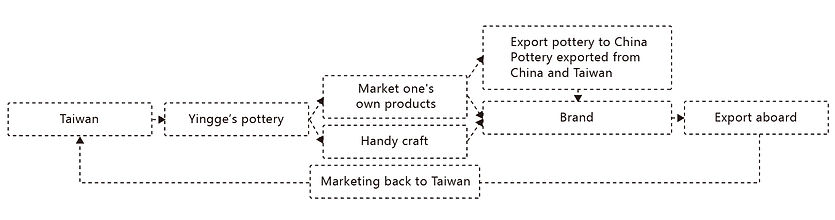
STEP 1: Screen Industry
Step 1:
According to the insights in previous interviews, establishing five screening indicators: basic condition, Inheritance, expanded opportunity, environment and politic to select and coach.
Step 2:
Conduct hierarchy evaluation of the industry from the five indicators.

Step 3:
Create a matrix to map out the status of industry and decide on the support order


STEP 2: The government started to support the industry
Taking Yingge as an example, the current development trend in Yingge's ceramic industry is to develop a corporate brand and expand product sales. Build a brand in Taiwan with brand development as the core and then export the products abroad and expand channels. After establishing brand awareness and stable marketing channels overseas, it returns to the Taiwan market. At the same time, holds local events and promotes each other with brands.
STEP 3: Establish a platform
Establish a platform that can be used for marketing supported industries, matching industry and plan promotion.
